Scif · Volume 1
Overview: What a SCIF Is and Why It Exists
1.1 The Room That Is Really a System
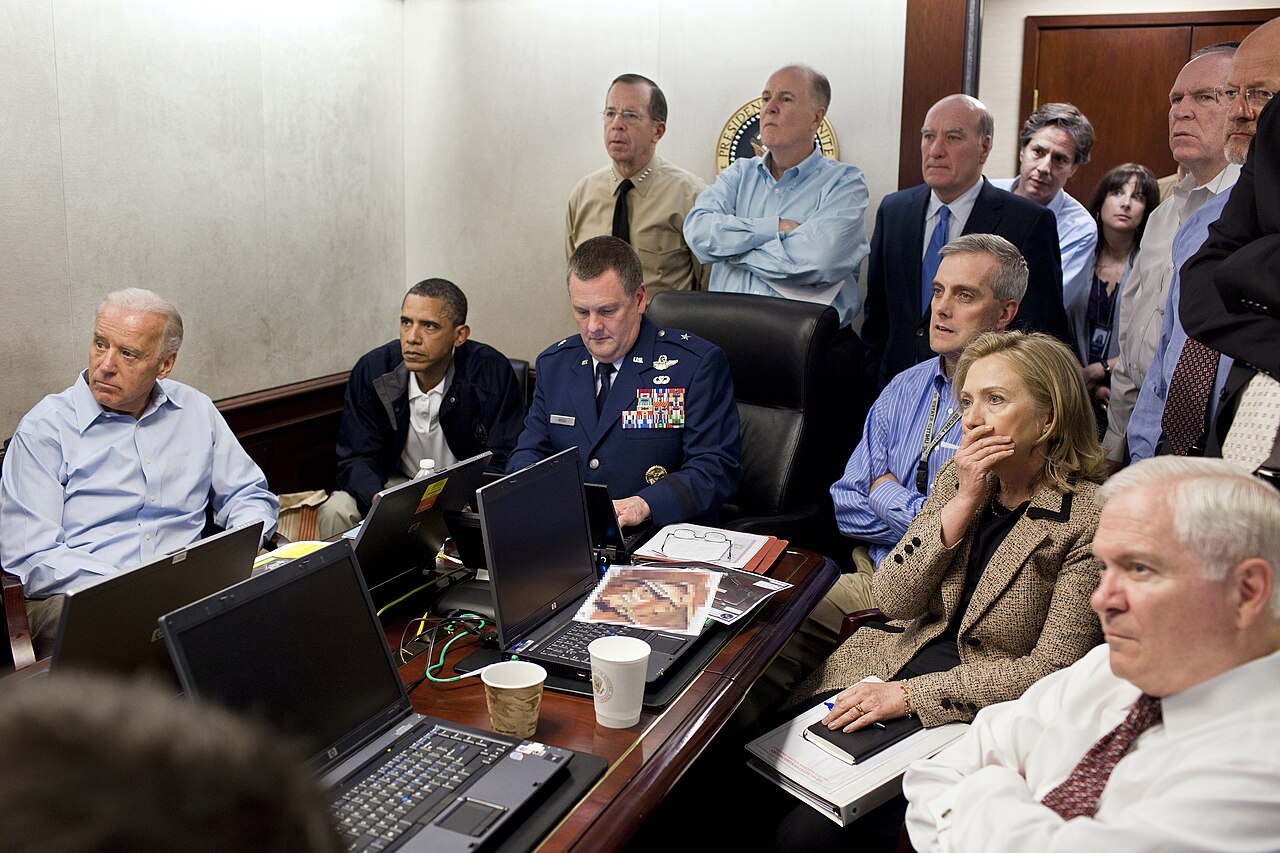
There is a particular kind of room that shows up in press photographs at exactly the moments when a government is deciding whether to do something irreversible. The people in it look ordinary. The furniture looks like it was ordered from the same catalog as everyone else’s conference table. What is not visible in the photograph is the reason the room exists at all: the walls, the door, the ceiling, the floor, the ductwork, the power feeds, and the network drops have all been engineered so that nothing said, shown, typed, or radiated inside the room can be recovered outside it without authorization. That room is a SCIF, and the photograph below is one of the most-reproduced pictures ever taken inside one.
SCIF is pronounced “skiff,” and it expands to Sensitive Compartmented Information Facility. The formal definition, taken almost verbatim from the governing directive, is disarmingly bureaucratic: a SCIF is an accredited area, room, group of rooms, building, or installation where Sensitive Compartmented Information may be stored, used, discussed, and/or electronically processed. Every word in that sentence is load-bearing. “Accredited” means an authority signed a piece of paper attesting that this specific space meets a specific standard; a room does not become a SCIF because it is strong, it becomes a SCIF because it is approved. “Stored, used, discussed, processed” enumerates the four ways sensitive information can leak — sitting in a safe, sitting on a screen, spoken aloud, or moving through wires and the air — and a SCIF is obligated to address all four. And “area, room, group of rooms, building, or installation” tells the engineer that a SCIF is a scale-invariant concept: it can be a converted closet or an entire hardened building, and the same governing logic applies at every size.
The single most useful idea to carry into the rest of this series is this: a SCIF is a system, not a vault door. The instinct of most people, including most engineers on first exposure, is to picture a thick door and a combination lock. That instinct is not wrong so much as it is a rounding error. A SCIF is a coordinated set of countermeasures — structural, acoustic, electromagnetic, procedural, and administrative — that only functions as a whole. A perfect vault door in an acoustically transparent wall protects nothing. A perfectly shielded enclosure whose one signal penetration was filtered by an unqualified contractor protects nothing. The discipline of SCIF design is the discipline of not having a weakest link, and the reason the paperwork is so heavy is that “no weakest link” is a claim someone has to be willing to certify.
1.2 SCI Versus Collateral: Why “Top Secret” Is Not the Top
To understand why the ordinary secure room is not enough, one first has to be precise about what a SCIF protects, because it is a narrower and stranger thing than “secret stuff.”
The United States classification system has three collateral levels: Confidential, Secret, and Top Secret. These are the familiar tiers, and the word “collateral” simply means classified information that is not subject to any additional formal access-control program beyond the clearance level itself. If a person holds a Top Secret clearance, they may, in principle, be granted access to any collateral Top Secret document for which they have a need to know.
Sensitive Compartmented Information, or SCI, sits alongside that ladder rather than above it, and this is the subtlety that trips people up. SCI is not a fourth classification level. It is a set of control systems and compartments layered on top of classified information — most often Top Secret, though information at lower levels can also live inside a control system. SCI is derived from, or reveals, intelligence sources and methods: how something was learned, not merely what was learned. Because the sources and methods are often more fragile and more valuable than any single fact they produce, access is restricted not just by clearance level but by explicit, individually granted “read-in” to a named compartment. These compartments are identified by classified codewords and organized into control systems — the community speaks of information being “SI” or “TK” or “HCS” controlled, and dissemination is further constrained by caveats. The colloquial phrase “above Top Secret” is technically a misnomer but captures the operational reality: holding a TS clearance does not entitle anyone to SCI. One must be individually indoctrinated into each compartment, sign the corresponding nondisclosure agreements, and be tracked on an access roster. When a fact is later “decompartmented,” it reverts to being ordinary collateral information at whatever level it carries.
Authority over this whole apparatus rests with the Director of National Intelligence (DNI). The DNI is the executive agent for SCI, sets the standards for the facilities that house it, and delegates accreditation authority downward. This is why a SCIF is fundamentally a DNI-governed construct even when it sits inside a Department of Defense building or a private contractor’s office park.
There is a close sibling worth naming now so the taxonomy is clean later. Special Access Programs (SAPs) are another category of enhanced-access controls, generally associated with the Department of Defense and Department of Energy rather than the intelligence community’s SCI systems. A program office may build a Special Access Program Facility (SAPF) to house SAP material, and — this is the practical point — SAPFs are built to substantially the same physical and technical construction standard as SCIFs. The intelligence community treats SCI and SAP as distinct kinds of controlled-access programs with distinct governance, but the building looks almost identical, because the physics of overhearing a conversation or intercepting a stray emission does not care which access-control bureaucracy owns the secret. Throughout this series, “SCIF” should be read as shorthand for “SCIF and its close relative the SAPF,” except where the governance distinction actually matters.
1.3 The Threat Model: Four Ways a Room Betrays You
The reason a normal locked office is inadequate becomes obvious once the threat is decomposed. A SCIF is designed against an adversary who is patient, technically capable, and already close — a hostile intelligence service that may control the building next door, the cleaning contract, the power utility, or the workers who poured the concrete. Against that adversary, the facility must close four distinct leakage domains simultaneously. It is worth walking each one, because the entire rest of the series is organized around defeating them.
Physical intrusion. The first and most intuitive domain is someone getting in — either by force or, more dangerously, covertly. Forced entry is the movie version: prying, cutting, drilling. Covert or surreptitious entry is the real nightmare, because its entire objective is to leave no trace, so that the facility keeps operating in the false belief that it is secure. Countermeasures here are the walls, the door and its hardware, the intrusion detection system, and the storage containers of last resort — GSA-approved security containers rated in man-minutes against covert entry and man-hours against surreptitious entry, numbers that are really statements about how long a defender’s alarm response has to beat an attacker’s tools. The concept that the physical shell buys time, not absolute denial, is central and recurs in Volume 6.
Acoustic. The second domain is overhearing. Human speech is a surprisingly effective and surprisingly leaky transmitter. Ordinary drywall partitions attenuate conversation poorly, and a partition that stops “at the drop ceiling” leaks freely over the top through the shared plenum. SCIF acoustic design is quantified in Sound Transmission Class (STC), an integer rating of how much a partition assembly reduces airborne sound. The governing tech spec frames the requirement around whether normal or amplified speech is intelligible on the uncontrolled side, and it sets STC targets for perimeter walls accordingly — roughly, a level at which normal conversation is unintelligible, and a higher level for spaces where amplified sound (a briefing, a speakerphone, a video conference) must also be contained. The engineering consequence is that a SCIF perimeter is a continuous acoustic envelope: walls that run slab-to-slab, sound-isolating treatment at every penetration, gasketed and swept doors, and sometimes sound-masking systems in the surrounding “buffer” space. Acoustics get their own deep treatment later, but the headline is that speech privacy is a measurable structural property, not a matter of closing the door and lowering one’s voice.
Visual. The third domain is the simplest to state and the easiest to forget: no unauthorized line of sight to materials, displays, or keyboards. Windows are minimized or eliminated; where they exist, they are treated for both visual and technical protection. Interior sightlines are managed so that an open door during a shift change does not expose a wall of screens to a corridor. This is not paranoia about telescopes across the street so much as recognition that the cheapest possible collection method is a person simply looking, and a facility that has spent a fortune on shielding but leaves a monitor visible through a propped door has defeated itself for free.
Technical and emanation security. The fourth domain is the one that makes SCIFs genuinely interesting to an electrical engineer, and it splits in two. The first half is audio surveillance and technical penetration — bugs, hidden microphones, exfiltration devices, and the compromise of installed equipment — countered by a discipline called Technical Surveillance Countermeasures (TSCM), colloquially “sweeps,” together with strict control over what electronics may enter the space. The second half is emanation security, governed by the body of practice known by the codeword TEMPEST. Every piece of electronic equipment that processes information also unintentionally radiates some correlate of that information — as electromagnetic fields, as conducted signals on power and ground, and even as acoustic or vibrational side effects. In principle, a sufficiently capable adversary at a sufficiently short distance can reconstruct the plaintext from these compromising emanations without ever touching the equipment.
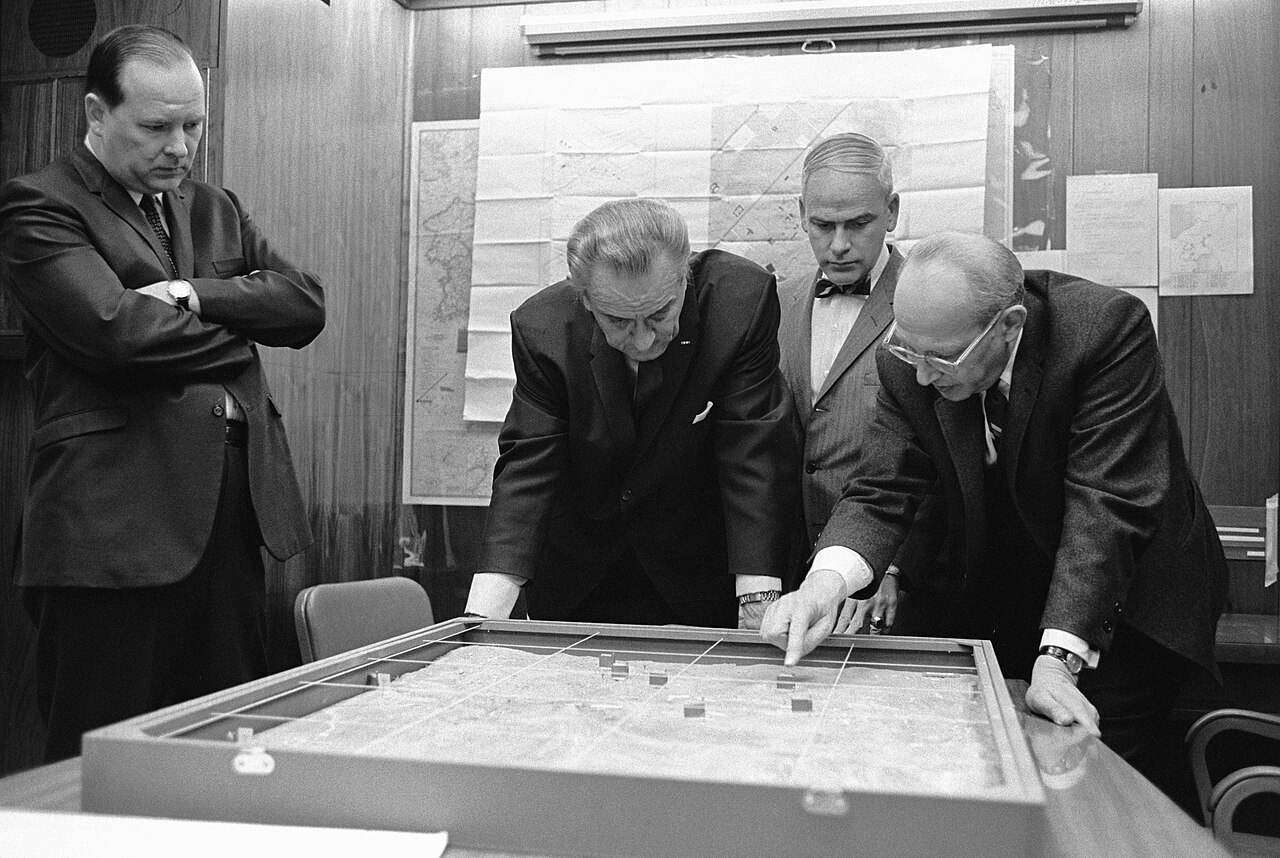
The defensive framework for emanations is built around two ideas an engineer will recognize instantly. The first is RED/BLACK separation: circuits and equipment that carry unencrypted classified information (“RED”) are physically separated, filtered, and isolated from circuits that carry unclassified or encrypted signals (“BLACK”), so that plaintext cannot couple onto a wire that leaves the protected zone. The second is shielding effectiveness, the attenuation in decibels that a barrier — a metal enclosure, a filtered penetration, a gasketed door — provides against RF energy over a band of frequencies. A shielded SCIF is, electrically, an attempt to build a room-sized Faraday enclosure whose every seam, door, window, pipe, conduit, and cable entry has been treated so that the enclosure’s real-world shielding effectiveness does not collapse at its weakest joint.
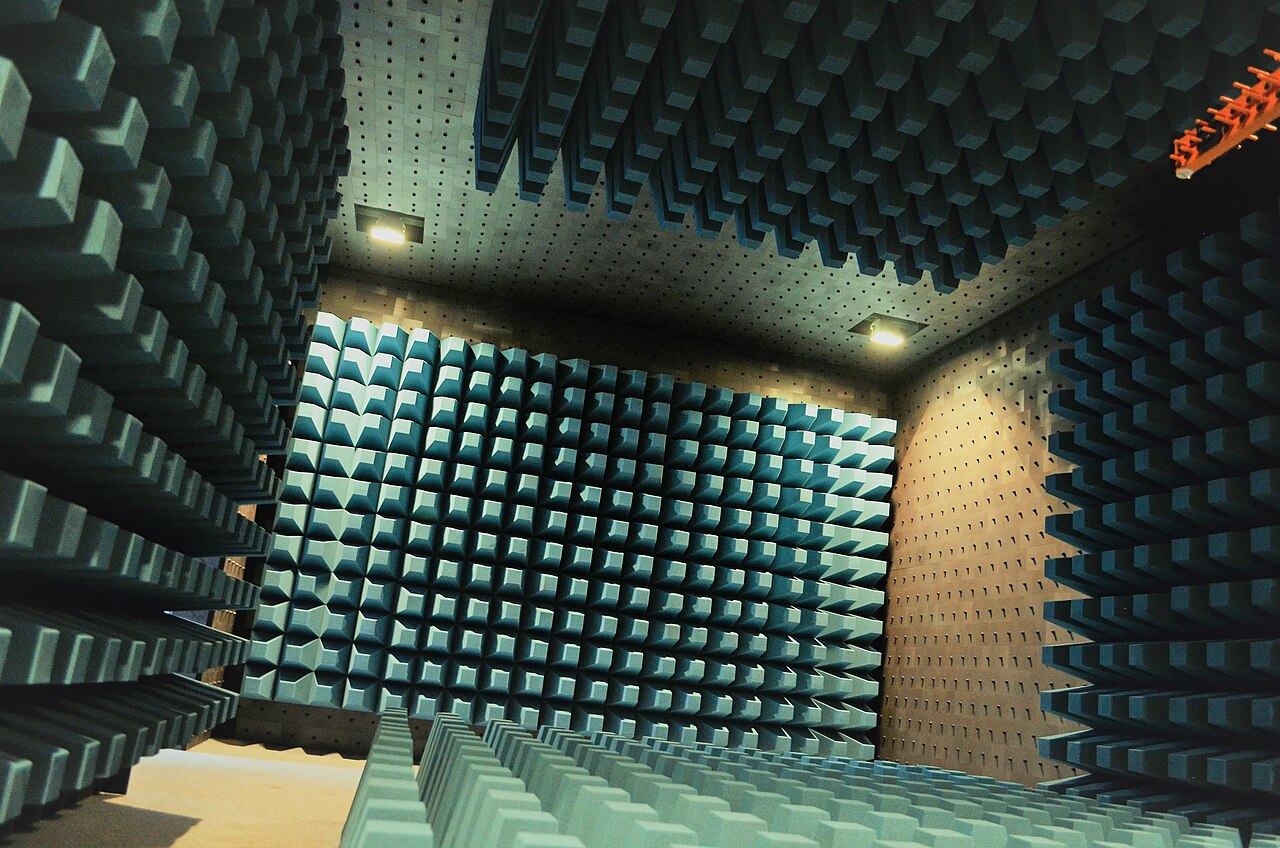
A crucial and deliberate limitation of this series belongs right here. The concepts of emanation security — that equipment radiates, that plaintext must be isolated from unprotected conductors, that shielding is measured in decibels, that separation distances and installation practices matter — are openly published and are the proper subject of engineering discussion. The specific numbers are not. The actual emanation limits, the zoning and separation distances, and the classified TEMPEST test standards are, well, classified, and inventing plausible-looking values would be both false and useless. This series describes the architecture and the physics; it does not, and will not, supply the operational parameters that exist only to be measured against a real accredited facility. That line is worth stating plainly once and then respecting throughout.
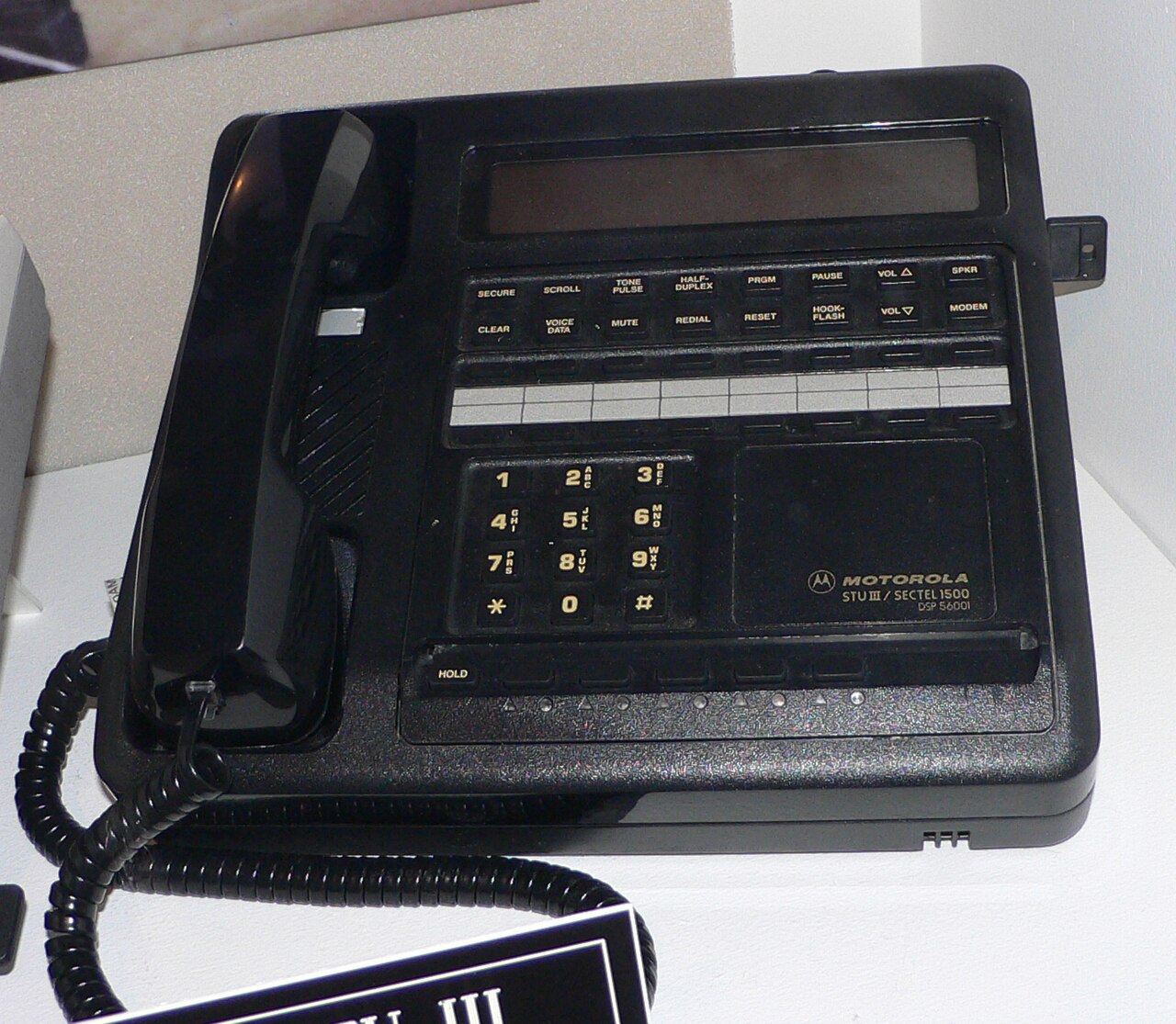
Secure communications equipment is where several of these domains meet. A secure telephone terminal is simultaneously a physical asset to be controlled, a RED device whose plaintext side must be isolated from the BLACK network, and a piece of keyed cryptographic material with its own handling rules. The now-retired STU-III family below is a good period illustration of the type — an ordinary-looking desk instrument that became a controlled cryptographic device the moment its key was inserted.
1.4 Who Says So: The Governance in One Breath
A facility that anyone can declare “secure” is worth exactly nothing, so the SCIF world is defined by a chain of authority and a set of documents. These get a full volume of their own later; the point of introducing them now is so the reader recognizes the names when they recur.
The capstone document is Intelligence Community Directive (ICD) 705, issued under the authority of the DNI. ICD 705 is famously short — a few pages — because it is a policy umbrella. Beneath it sit the implementing standards, ICS 705-1 and ICS 705-2, and beneath those sits the document that does the real engineering work: the IC Technical Specification for ICD/ICS 705, universally called the Tech Spec. The Tech Spec is where STC targets, wall constructions, penetration treatments, door hardware, alarm requirements, and the rest live in specific, buildable language. An engineer approaching this field for the first time should think of ICD 705 as the mission statement and the Tech Spec as the datasheet.
ICD 705 did not appear from nothing. It consolidated and superseded an older regime — most notably Director of Central Intelligence Directive (DCID) 6/9, the physical security standard that governed SCIFs before the 2008 reorganization of the intelligence community placed the DNI in charge. That lineage matters because a great deal of surviving infrastructure, institutional habit, and even vocabulary traces to the DCID era, and older facilities were accredited against it. The history and the standards each get their own volume.
Three roles complete the picture. The Accrediting Official (AO) — sometimes styled the Cognizant Security Authority — is the person or office empowered to accept the residual risk and formally accredit the facility; nothing is a SCIF until the AO says so, and accreditation can be withdrawn. The Special Security Officer (SSO) or Special Security Manager (SSM) is the person who runs an accredited SCIF day to day: managing access rosters, indoctrinations, the standard operating procedures, and the endless small acts of compliance that keep an accreditation alive. And the Site Security Manager, during construction, is accountable for the integrity of the build itself against tampering. These are introduced here only as names on an org chart; Volume 3 gives them their proper treatment.
1.5 The Concentric Rings
The mental model that ties the physical countermeasures together is defense in depth expressed as a set of concentric security rings, each buying time or reducing risk before the next. Working from the outside in: a perimeter — a fence line, a controlled installation boundary, a lobby — establishes the outermost controlled zone. Inside that sits the building, itself access-controlled. Inside the building sits the SCIF perimeter proper, the accredited envelope with its hardened walls and single controlled entrance. And inside the SCIF there may be a further closed area or vault for open storage of the most sensitive material. An adversary must defeat each ring in turn, and each ring is designed on the assumption that the ones outside it may fail.
Two concepts from this model deserve early names. Inspectable space is the zone around and within a facility that the organization controls well enough to detect a hostile technical collector — the practical radius within which emanation and eavesdropping threats can be managed. Where an organization does not control that surrounding space, the analysis changes, which is precisely why a SCIF in a leased commercial high-rise is a harder problem than one on a fenced military installation. Co-utilization is the arrangement by which more than one organization shares a single accredited SCIF under a memorandum of agreement — sensible for cost, but it multiplies the number of people, access rosters, and standard operating procedures the SSO must reconcile, and it means the ring model has to account for tenants who trust each other only conditionally.
1.6 A Field Guide to SCIF Types
The series returns repeatedly to a handful of distinctions, so it is worth laying out the taxonomy in one place. None of these are mutually exclusive; a real facility is described by picking one option from each axis.
Open storage versus closed storage. In an open-storage SCIF, SCI material may be left out — on desks, on whiteboards, in unlocked stacks — during operations, because the entire accredited room functions as the container. This demands the most robust construction, because the walls themselves are the safe. In a closed-storage SCIF, SCI must be secured inside GSA-approved security containers whenever the space is unoccupied; the room protects discussion and processing, but the containers protect stored material. Open storage costs more to build and less to operate; closed storage is the reverse. Which one an organization chooses is a straightforward engineering-economics trade, and it drives the entire wall and alarm specification.
Permanent versus temporary. A permanent SCIF is a fixed, indefinitely accredited installation. A temporary SCIF — including the battlefield article known as a T-SCIF — is stood up for a bounded period or a specific operation, accredited under expedited provisions with the understanding that some permanent-facility protections are replaced by procedural and personnel measures. The T-SCIF is where SCIF doctrine meets the reality that intelligence still has to be handled in a tent in a place where no one poured a slab-to-slab wall.
Fixed versus mobile or transportable. Beyond the fixed building lies an entire family of mobile SCIFs built into shelters, trailers, and expandable containers that can be trucked or flown into position and accredited on arrival. The rigid-wall tactical shelter below is representative of the platform on which a transportable secure facility is built — a hard, expandable box engineered so that the same acoustic, physical, and technical protections can travel.
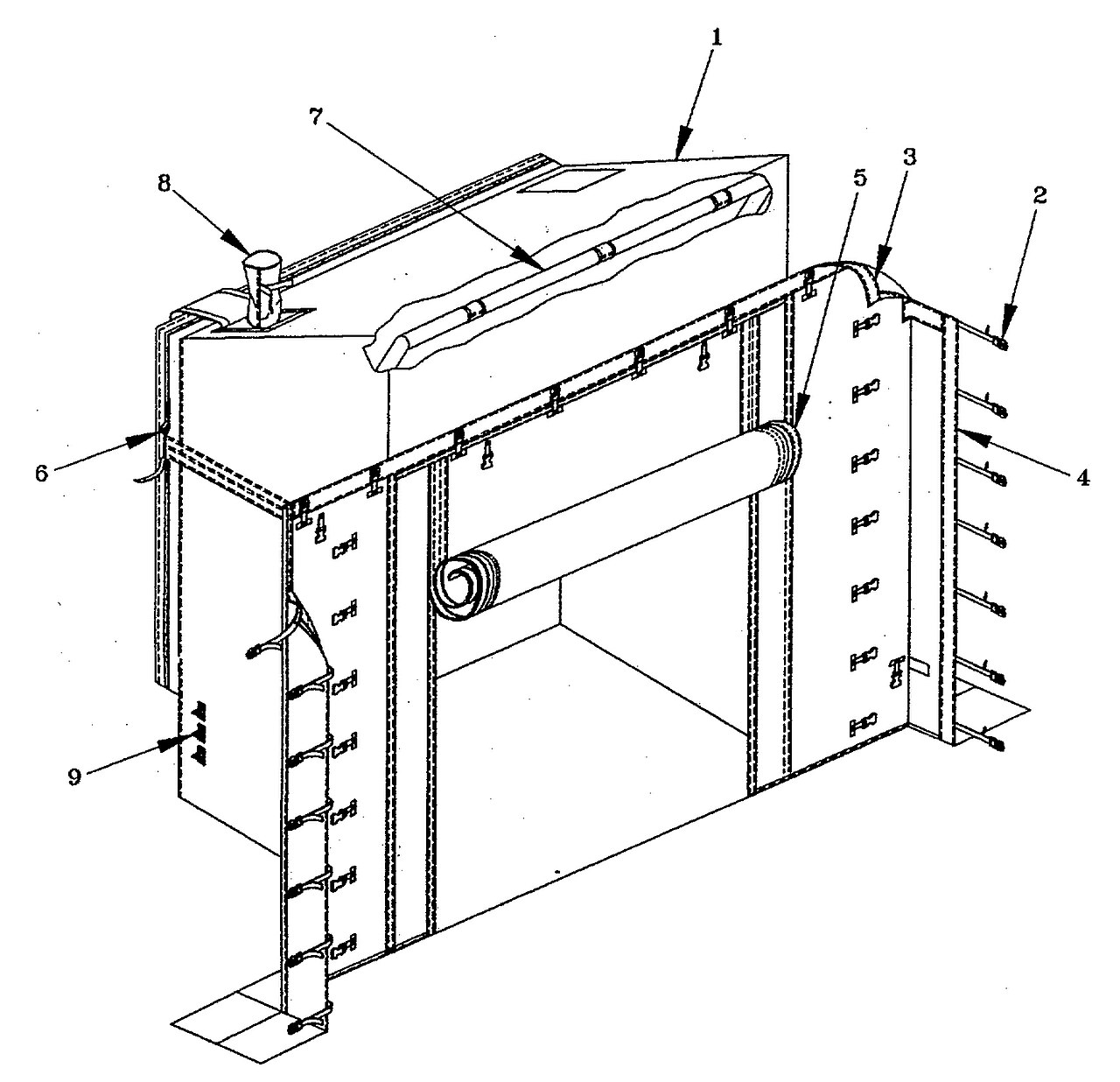
Ground versus airborne versus shipboard. Finally, the platform axis. Most SCIFs are ground-based, but SCI is also handled aboard aircraft and ships, and each environment imposes its own constraints — weight, vibration, grounding and bonding to a moving conductive hull, the impossibility of a static “inspectable space” around a vehicle in motion. A shipboard SCIF and a converted office suite share a governing standard and almost nothing else about their engineering.
1.7 What the Rest of the Series Covers
This volume is the front door; the deep work is in the volumes that follow. In brief:
- Volume 2 — History. How the SCIF concept evolved from wartime map rooms and the hard lessons of embassy bugging and emanation compromise into a codified discipline, and how the standards migrated from the DCID era to ICD 705.
- Volume 3 — Standards and governance. ICD 705, ICS 705-1/-2, and the Tech Spec in detail, plus the AO, SSO/SSM, and Site Security Manager roles and the accreditation lifecycle.
- Volume 4 — Government uses. Where SCIFs actually sit — the White House complex, the Pentagon, embassies, combatant commands, and the tactical edge — and how mission shapes construction.
- Volume 5 — Civilian and commercial uses. Cleared contractors, the growing world of privately built SCIFs, and the odd cases (elected officials, private residences) that make the news.
- Volume 6 — Construction: the shell. Wall, floor, and ceiling assemblies; slab-to-slab perimeters; achieving STC targets; forced- and covert-entry resistance in structural terms.
- Volume 7 — Construction: the openings. The hard part — doors, windows, and every utility, mechanical, and communications penetration, each of which is a hole someone had to make disappear acoustically, physically, and electromagnetically.
- Volume 8 — RF and TEMPEST shielding. The room as a Faraday enclosure: shielding effectiveness in decibels, architectural versus fully shielded construction, and the openly published physics of emanation security.
- Volume 9 — Getting signals and power in and out. Filtered power, fiber and copper penetrations, waveguides-below-cutoff for air and fluids, grounding and bonding, and RED/BLACK installation practice.
- Volume 10 — Access control and accreditation. Intrusion detection, the man-minutes/man-hours logic, access control systems, TSCM, and the paperwork that turns a strong room into an accredited SCIF.
- Volume 11 — Building your own. How the standards and physics come together in a realistic design exercise, and where the genuine engineering difficulty lives.
- Volume 12 — Reference. The consolidated public document set, glossary, and pointers.
1.8 Why an Engineer Should Care
Strip away the acronyms and the SCIF resolves into a set of problems that any experienced engineer will find familiar, uncomfortably interlocked, and honestly rather elegant.
It is an acoustics problem: build a continuous partition envelope that holds a specified STC across every joint and penetration, in a structure that also has to breathe, carry power, and let people in and out.
It is an RF and electromagnetics problem: build a room-sized shielded enclosure whose measured shielding effectiveness does not collapse at its weakest seam, filter every conductor that crosses the boundary, and manage grounding and RED/BLACK separation so that plaintext never couples onto a wire headed for the uncontrolled world.
It is a physical-security problem: assemble structure, hardware, sensing, and response so that the total time an adversary needs exceeds the total time a defender has, at every point on the perimeter and down to the container of last resort.
It is a supply-chain and integrity problem, which engineers underrate at their peril: the countermeasures are only as trustworthy as the people and materials that built them, which is why construction security — who touched the walls, and whether anything was installed that should not have been — is itself a controlled discipline rather than an afterthought.
And wrapped around all of it is a paperwork problem, because none of the engineering counts until an accountable official is willing to certify that it counts, and because the certification is revocable the moment the system drifts out of specification. That is not bureaucracy for its own sake; it is the mechanism by which a physical claim (“this room does not leak”) is converted into an institutional guarantee that other people can rely on without re-deriving it themselves.
The rest of this series takes each of those problems apart. The thing to keep in mind, from the first volume to the last, is the sentence at the top: a SCIF is a system, not a vault door. Everything that follows is an elaboration of what it takes to make that system have no weakest link — and of how one proves it.
Sources
- Office of the Director of National Intelligence, Intelligence Community Directive 705, “Sensitive Compartmented Information Facilities.” dni.gov. https://www.dni.gov/files/documents/ICD/ICD-705-SCIFs.pdf
- ODNI / National Counterintelligence and Security Center, IC Technical Specification for ICD/ICS 705, “Technical Specifications for Construction and Management of Sensitive Compartmented Information Facilities” (the “Tech Spec”). https://www.dni.gov/files/NCSC/documents/Regulations/IC_Technical_Specifications_for_Construction_and_Management_of_Sensitive_Compartmented_Information_Facilities_v151_PDF.pdf
- Director of Central Intelligence Directive (DCID) 6/9, “Physical Security Standards for Sensitive Compartmented Information Facilities” (historical; superseded by ICD 705). Federation of American Scientists Intelligence Resource Program. https://irp.fas.org/offdocs/dcid6-9.htm
- Wikipedia, “Sensitive Compartmented Information Facility” and “Sensitive Compartmented Information.” https://en.wikipedia.org/wiki/Sensitive_compartmented_information_facility ; https://en.wikipedia.org/wiki/Sensitive_compartmented_information
- Center for Development of Security Excellence (CDSE / DCSA), SCI Refresher Course glossary and Classified Storage Requirements student guides. https://www.cdse.edu
- U.S. General Services Administration, “Types of security containers” and Class 5 / Class 6 security-container specifications. https://www.gsa.gov/buy-through-us/purchasing-programs/requisition-programs/gsa-global-supply/national-stock-numbers/security-containers
- NACSIM 5000, “TEMPEST Fundamentals” (redacted public release) and general TEMPEST / RED-BLACK background. Cryptome. https://cryptome.org ; Wikipedia, “Tempest (codename).” https://en.wikipedia.org/wiki/Tempest_(codename)
- U.S. Department of Defense, UFC 4-010-05, “Sensitive Compartmented Information Facilities (SCIF) / SAPF Planning, Design, and Construction.” NAVFAC EXWC DoD Lock Program. https://exwc.navfac.navy.mil/Portals/88/Documents/EXWC/DoD_Locks/PDFs/UFC_4-010-05.pdf
- Wikipedia, “STU-III” (secure telephone lineage). https://en.wikipedia.org/wiki/STU-III
- The Washington Post, “What is a SCIF?” explanatory feature (journalism, general audience). https://www.washingtonpost.com/national-security/interactive/2023/scif-room-meaning-classified/
Comments (0)